Traditional textiles have long been the foundation of cultural identity, craftsmanship, and storytelling across civilizations. In the 21st century, these age-old fabrics are not fading into history; instead, they are evolving, adapting, and finding renewed relevance in a rapidly changing global fashion landscape. From handwoven heritage to contemporary design, traditional textiles continue to shape how culture and creativity intersect today.
Traditional Textiles as a Reflection of Cultural Heritage
Traditional textiles have always served as visual narratives of regional identity, social customs, and historical legacy. Each weave, motif, and dye technique reflects generations of artisans who preserved cultural values through fabric.
In India especially, these textiles communicate stories of geography, climate, and tradition—whether it is the richness of Banarasi silk or the vibrancy of bandhani. Their enduring presence highlights how fabric can become a cultural archive passed down through time.
Traditional Textiles in Pre-Modern Societies
Textiles once played a central role in everyday life, ceremonial dressing, and social status. Long before industrial production, fabrics were crafted slowly, intentionally, and often locally.
Communities depended on handloom weaving, natural dyes, and indigenous materials to create textiles suited to their environment. These practices ensured sustainability long before the term existed, embedding responsibility and respect for resources into textile traditions.
The Impact of Industrialisation
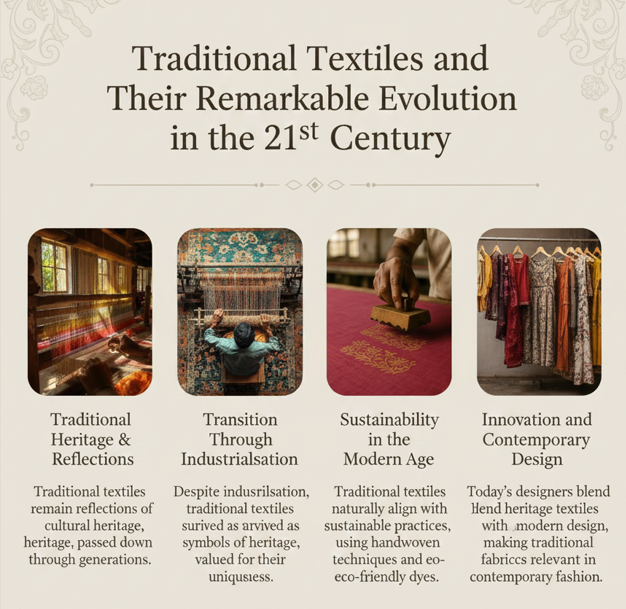
Traditional textiles faced significant challenges during industrialisation as machine-made fabrics replaced handcrafted ones. Mass production introduced speed, affordability, and uniformity—but often at the cost of individuality and craftsmanship.
Despite this shift, many artisan communities continued their practices, preserving techniques that would later be recognised as invaluable cultural assets. This period marked a turning point where traditional textiles moved from everyday essentials to symbols of heritage.
Traditional Textiles in the Era of Globalisation
It entered a new phase of transformation as globalisation connected markets, designers, and consumers worldwide. Cultural exchange brought renewed interest in handcrafted fabrics beyond their regions of origin.
Designers began sourcing traditional materials for international collections, introducing heritage textiles to global audiences. This exposure helped reposition them as luxury, ethical, and artisanal rather than outdated or regional.
Traditional Textiles and Sustainable Fashion Movements
Traditional textiles align naturally with the values of sustainability, slow fashion, and ethical production. Handloom weaving, natural fibres, and low-impact processes make these textiles environmentally responsible by design.
As consumers become more conscious of fashion’s environmental impact, traditional craftsmanship offers an alternative rooted in durability, transparency, and human skill. This shift has played a key role in the modern revival of heritage fabrics.
Contemporary Design and Innovation
Traditional textiles are no longer limited to classic silhouettes or ceremonial wear. Contemporary designers reinterpret them through modern cuts, experimental styling, and cross-cultural fusion.
By blending heritage fabrics with global aesthetics, designers create pieces that feel relevant to modern lifestyles. This evolution allows traditional textiles to exist comfortably in both everyday fashion and high-end design spaces. Read more
Traditional Textiles and Technological Advancements
Textiles have also adapted through the thoughtful integration of technology. Digital design tools, improved dyeing techniques, and e-commerce platforms have helped artisans reach wider audiences.
Technology supports documentation, quality control, and storytelling—ensuring that craftsmanship is preserved while remaining commercially viable. This balance allows heritage techniques to survive without losing authenticity.
Traditional Textiles in Modern Indian Fashion
It continue to hold strong relevance in modern Indian fashion, influencing everyday wear, festive clothing, and contemporary fusion styles. Designers increasingly combine heritage fabrics with modern silhouettes to appeal to younger audiences.
From office wear to casual styling, these textiles are now worn in more versatile and accessible ways. This adaptability ensures that tradition remains part of daily life rather than being limited to special occasions.
Symbols of Identity and Pride
Traditional textiles today represent more than fashion—they symbolise identity, pride, and continuity. Wearing heritage fabrics becomes a conscious choice to support craftsmanship, history, and cultural expression.
For many, these textiles create a sense of belonging in a globalised world, offering a tangible connection to roots while embracing modern individuality.
Traditional Textiles and the Future of Fashion
Tradition is poised to play a crucial role in the future of fashion as the industry shifts toward sustainability and authenticity. Their emphasis on craftsmanship, durability, and ethical production aligns with evolving consumer values.
As innovation continues, these textiles will keep adapting—proving that heritage and progress are not opposites but partners in shaping meaningful fashion narratives.
A Living Legacy in the 21st Century
Traditional textiles remain living traditions rather than static relics of the past. Their evolution in the 21st century demonstrates resilience, creativity, and relevance in a rapidly changing world.
By embracing innovation while honouring heritage, traditional textiles continue to tell stories that transcend time. They remind us that true progress lies not in replacing tradition, but in allowing it to evolve thoughtfully—thread by thread, generation by generation.